So .... T minus I don't know how many hours .... or what T minus blah actually means.
We're leaving tomorrow morning; my mom joined me here in San Francisco this afternoon we're about to order to take-out Chinese while we sit and go through the three different currency exchange rates, weather and time changes we're about to get to live through.
Here's the breakdown:
Thailand
GMT/UTC + 07:00 hour
15 Hours Ahead Pacific Standard Time
300 Thai Bhat = 10 US Dollars
Weather: 78 degrees Farenheit currently
Nepal
GMT/UTC + 05:45 hour
13 Hours And 45 Minutes Ahead Of Pacific Standard Time
707.55 Nepali Rupee = 10 US Dollars
Weather: 62 degrees Farenheit currently
Bhutan
GMT/UTC + 06:00 hour
14 Hours Ahead Pacific Standard Time
440 Bhutanese Ngultrum = 10 US Dollars
Weather: 50 degrees Farenheit currently
So, yes, for those of you paying attention there is a 15 minutes time difference between Nepal and Bhutan.
The weather for at least the next 5 days is looking pretty good all the way around. Hopefully this portends very smooth flight schedules.
Monday, February 19, 2007

Sunday, February 18, 2007
Meanwhile In Nepal .....
A few people asked me if it is safe to travel in Nepal. The short answer is - I hope so.
It seems there have been a few issues with some Maoists in Nepal
"Nepal’s brutal conflict between Maoist insurgents and security forces has exacted a heavy toll on the civilian population, especially those in contested hill districts, many of whom already live near or on the global poverty threshold. An estimated 12,000 people have been killed since the Maoist faction of the Communist Party of Nepal, officially launched its “people’s war” in February 1996."
In November of last year peace talks ended with the signing of a deal between Prime Minister Girija Prasad Koirala and Maoist leader Prachanda. The deal allows the Maoists to take part in government, and places their weapons under UN monitoring.
Today I read that the first phase of disarming Nepal’s Maoists and registering combatants housed in camps in the Himalayan nation is over. The United Nations called this a key step in a peace deal that ended a deadly civil war.
It seems there have been a few issues with some Maoists in Nepal
"Nepal’s brutal conflict between Maoist insurgents and security forces has exacted a heavy toll on the civilian population, especially those in contested hill districts, many of whom already live near or on the global poverty threshold. An estimated 12,000 people have been killed since the Maoist faction of the Communist Party of Nepal, officially launched its “people’s war” in February 1996."
In November of last year peace talks ended with the signing of a deal between Prime Minister Girija Prasad Koirala and Maoist leader Prachanda. The deal allows the Maoists to take part in government, and places their weapons under UN monitoring.
Today I read that the first phase of disarming Nepal’s Maoists and registering combatants housed in camps in the Himalayan nation is over. The United Nations called this a key step in a peace deal that ended a deadly civil war.
The Treasure Revealers Of Bhutan
So, you've had the Guru Rinpoche primer now lets talk about the tertöns or treasure revealers.
The teachings given by Guru Rinpoche in the 8th century were often written down by Yeshe Tsogyal, one of the queens of Tibet, and then hidden in various places for future generations.
There would be some precise time in the future that these treasures or termas would be found by a tertön - or treasure revealer.
The termas could be physical scrolls, statues, other holy objects, or information hidden in the mindstream of Guru Rinpoche's disciples as reborn spiritual masters, led to discover the terma through dreams, visions, and spontaneous realization.
The discoveries wouldn't happen randomly, not by somebody bumping into a terma somewhere. Padmasambhava predicted very specifically who and when each one would be discovered.
There have been many hundreds of tertöns up to this present day who have revealed thousands of these concealed teachings of Guru Rinpoche.
The teachings given by Guru Rinpoche in the 8th century were often written down by Yeshe Tsogyal, one of the queens of Tibet, and then hidden in various places for future generations.
There would be some precise time in the future that these treasures or termas would be found by a tertön - or treasure revealer.
The termas could be physical scrolls, statues, other holy objects, or information hidden in the mindstream of Guru Rinpoche's disciples as reborn spiritual masters, led to discover the terma through dreams, visions, and spontaneous realization.
The discoveries wouldn't happen randomly, not by somebody bumping into a terma somewhere. Padmasambhava predicted very specifically who and when each one would be discovered.
There have been many hundreds of tertöns up to this present day who have revealed thousands of these concealed teachings of Guru Rinpoche.
Who Was Guru Rinpoche?
For those of you who didn't make it all the way through the wikipedia entry for Padmasabhava I'll give you the reader's digest version.
Padmasambhava, in Sanskrit meaning "lotus-born", is said to have brought Tantric Buddhism to Tibet in the 8th century. In Bhutan and Tibet he is better known as Guru Rinpoche ("Precious Master") where followers of the Nyingma school regard him as the second Buddha.
According to tradition, Padmasambhava was incarnated as an 8 year old child appearing in a lotus blossom floating in Lake Dhanakosha, in the kingdom of Uddiyana, traditionally identified with the Swat Valley of present-day Pakistan. His special nature was recognized by the local king who married him to one of his daughters, Mandarava. Mandarava and Padmasambhava's other main consort, Yeshe Tsogyal, developed into realised practitioners.
Padmasambhava's ability to memorize and comprehend esoteric texts in a single hearing established his reputation as a master above all others. Accused of the mystical killing of an evil minister, he was banished from the court and freely chose to live in a cemetery district. Transiting various heavens and hells, he developed the power to transcend the cycle of birth and death, accomplishing the so-called great transference.
Trisong Deutson, the 38th king of Tibet (742-797), whose kingdom was beset by evil mountain deities invited Padmasambhava to Tibet where he used his tantric powers to subdue the evil deities he encountered along the way, eventually receiving the Emperor's wife, identified with the dakini Yeshey Tsogyel, as a consort. This was in accordance with the tantric principle of not eliminating negative forces but instead redirecting them to fuel the journey toward spiritual awakening. In Tibet he founded the first monastery in the country Samye Gompa, initiated the first monks, and introduced the people to the practice of Tantric Buddhism.
Padmasambhava, in Sanskrit meaning "lotus-born", is said to have brought Tantric Buddhism to Tibet in the 8th century. In Bhutan and Tibet he is better known as Guru Rinpoche ("Precious Master") where followers of the Nyingma school regard him as the second Buddha.
According to tradition, Padmasambhava was incarnated as an 8 year old child appearing in a lotus blossom floating in Lake Dhanakosha, in the kingdom of Uddiyana, traditionally identified with the Swat Valley of present-day Pakistan. His special nature was recognized by the local king who married him to one of his daughters, Mandarava. Mandarava and Padmasambhava's other main consort, Yeshe Tsogyal, developed into realised practitioners.
Padmasambhava's ability to memorize and comprehend esoteric texts in a single hearing established his reputation as a master above all others. Accused of the mystical killing of an evil minister, he was banished from the court and freely chose to live in a cemetery district. Transiting various heavens and hells, he developed the power to transcend the cycle of birth and death, accomplishing the so-called great transference.
Trisong Deutson, the 38th king of Tibet (742-797), whose kingdom was beset by evil mountain deities invited Padmasambhava to Tibet where he used his tantric powers to subdue the evil deities he encountered along the way, eventually receiving the Emperor's wife, identified with the dakini Yeshey Tsogyel, as a consort. This was in accordance with the tantric principle of not eliminating negative forces but instead redirecting them to fuel the journey toward spiritual awakening. In Tibet he founded the first monastery in the country Samye Gompa, initiated the first monks, and introduced the people to the practice of Tantric Buddhism.
In Bhutan he is associated with the famous Taktshang or "Tiger's Nest" monastery built on a sheer cliff wall about 500m above the floor of Paro valley. He flew there from Tibet on the back of his favorite consort, Yeshe Tsogyal, who he transformed into a flying tigress for the purpose of the trip. Later he traveled to Bumthang district to subdue a powerful deity offended by a local king. Padmasambhava's body imprint can be found in the wall of a cave at nearby Kurje Lhakhang temple.
Padmasambhava also hid a number of religious treasures (termas) in lakes, caves, fields and forests of the Himalayan region to be found and interpreted by future tertöns or spiritual treasure finders. According to Tibetan tradition, the Bardo Thodol, (commonly referred to as the Tibetan Book of the Dead) was among these hidden treasures, subsequently discovered by a Tibetan terton, Karma Lingpa.
Maps For Your Pleasure
A lot of Westerners or better put Americans have a tenuous grasp on geography that exists beyond their noses. There are a million different reasons why and this blog isn't the place for a recitation of them. Suffice to say when I mentioned to friends that I was thinking about going to Bhutan a fair number of them had to consult a map to locate said country.
So for those of you, like me, who may struggle with geography here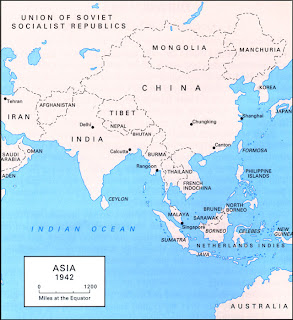
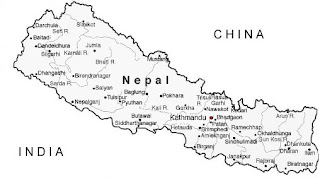 are some maps:

So for those of you, like me, who may struggle with geography here

 are some maps:
Will We Join The Communal BBQ On Our Way To The Caves?
Sounds nice doesn't it?
Well, I suppose I should explain in a little greater detail what this one entails.
Once we get back to Nepal after our time in Bhutan we are gonna cool our heals for about 5 days in the Kathmandu Valley. There will be *plenty* to see and do. I have a couple of ideas for day trips around the Valley one of which includes a visit to the caves in Pharping.
The Padmasambhava Cave in Pharping has its name after Padmashambhava, widely know as Guru Rinpoche. In the 18th century A.D. he meditated in these caves for about 6 months, while he was on his way to Tibet at an invitation by Tibet King Tshering Dechen. As he acquired mystic power, he checked himself by carving his palm print by melting the rock, which can still be seen above the entrance of this cave.
On the way to Pharping there is an important Hindu temple to visit.
Dakshinkali Temple dedicated to Kali, the fearful form of Lord Siva’s consort, Parvati. The main deity in the temple is the black stone, six-armed form of Kali, standing on a prostrated figure.
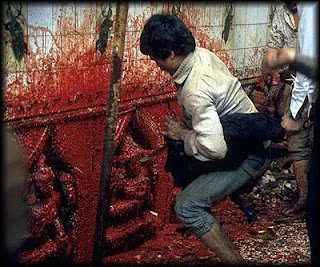
Dakshinkali is at the south end of the valley between two hills and at the confluence of two rivers. Sacrifices are made two times a week at this temple. The animals sacrificed have to be unsaturated males. Saturday is the main day and there are also sacrifices on Tuesdays.
When I first read about Dakshinkali I wasn't too keen on attending the sacrifice but I've come around to it particularly after one of my coworkers pointed out to me that in the end everyone gets a piece of meat and it turns into a communal bbq. Not so sure my mom will get behind this trip. Might be a solo venture :-)!
Caves at Pharping & Sacrifice At Dakshinkali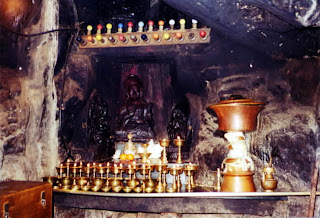
Well, I suppose I should explain in a little greater detail what this one entails.
Once we get back to Nepal after our time in Bhutan we are gonna cool our heals for about 5 days in the Kathmandu Valley. There will be *plenty* to see and do. I have a couple of ideas for day trips around the Valley one of which includes a visit to the caves in Pharping.
The Padmasambhava Cave in Pharping has its name after Padmashambhava, widely know as Guru Rinpoche. In the 18th century A.D. he meditated in these caves for about 6 months, while he was on his way to Tibet at an invitation by Tibet King Tshering Dechen. As he acquired mystic power, he checked himself by carving his palm print by melting the rock, which can still be seen above the entrance of this cave.
On the way to Pharping there is an important Hindu temple to visit.
Dakshinkali Temple dedicated to Kali, the fearful form of Lord Siva’s consort, Parvati. The main deity in the temple is the black stone, six-armed form of Kali, standing on a prostrated figure.
Dakshinkali is at the south end of the valley between two hills and at the confluence of two rivers. Sacrifices are made two times a week at this temple. The animals sacrificed have to be unsaturated males. Saturday is the main day and there are also sacrifices on Tuesdays.
When I first read about Dakshinkali I wasn't too keen on attending the sacrifice but I've come around to it particularly after one of my coworkers pointed out to me that in the end everyone gets a piece of meat and it turns into a communal bbq. Not so sure my mom will get behind this trip. Might be a solo venture :-)!
Caves at Pharping & Sacrifice At Dakshinkali


Chortens And Stupas And Gompas - Oh My!
Okay, it's time to break this down for you folks at home.
What's the difference between Chortens, Stupas and Gompas?
Glad you asked because I'm still trying to sort that out for myself.
Let's get with our friend Wikipedia and sort it out:
Gompas are Buddhist temples (typically forming monasteries or nunneries, Sanskrit name vihara), located in Tibet, Ladakh (India), Nepal, and Bhutan. Their design and interior details vary from region to region, however, all follow a general layout of a central prayer hall containing a Buddha statue, benches for the monks or nuns to engage in prayer or meditation and attached living accommodation. The gompa may also be accompanied by any number of stupas.
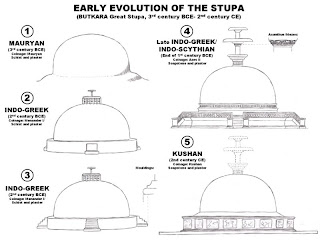
A stupa (from the Pāli) is a type of Buddhist structure found across the Indian subcontinent, Asia and increasingly in the Western World. Stupas are known in many Southeast Asian countries as chedi (from a Pāli synonym of stupa); in some countries (particularly Sri Lanka) as dagoba (from Sanskrit dhatu- element, component, or relic + garbha - storehouse or repository); or as tope (from Hindi top, derived from Sanskrit stūpa, a heap).
Fundamentally, a stupa is essentially made up of the following five constituents:
What's the difference between Chortens, Stupas and Gompas?
Glad you asked because I'm still trying to sort that out for myself.
Let's get with our friend Wikipedia and sort it out:
Gompas are Buddhist temples (typically forming monasteries or nunneries, Sanskrit name vihara), located in Tibet, Ladakh (India), Nepal, and Bhutan. Their design and interior details vary from region to region, however, all follow a general layout of a central prayer hall containing a Buddha statue, benches for the monks or nuns to engage in prayer or meditation and attached living accommodation. The gompa may also be accompanied by any number of stupas.
A stupa (from the Pāli) is a type of Buddhist structure found across the Indian subcontinent, Asia and increasingly in the Western World. Stupas are known in many Southeast Asian countries as chedi (from a Pāli synonym of stupa); in some countries (particularly Sri Lanka) as dagoba (from Sanskrit dhatu- element, component, or relic + garbha - storehouse or repository); or as tope (from Hindi top, derived from Sanskrit stūpa, a heap).
Fundamentally, a stupa is essentially made up of the following five constituents:
a). A square base
b). A hemispherical dome
c). A conical spire
d). A crescent moon
e). A circular disc
Each of these components is rich in metaphoric content and is identified with one of the five cosmic elements said to make up the entire manifested existence. These are earth, water, fire, air and space.
Chorten is the regional name for a stupa in both Tibet and Bhutan and as my mother and I like to remind each other one must be sure to walk clockwise around the chortens!
Subscribe to:
Posts (Atom)